
Clinical Decision Support for Chronic Pain Management and Shared Decision-Making IG
0.1.0 - CI Build
Clinical Decision Support for Chronic Pain Management and Shared Decision-Making IG
0.1.0 - CI Build
Clinical Decision Support for Chronic Pain Management and Shared Decision-Making IG - Local Development build (v0.1.0). See the Directory of published versions
Through its Accelerating Change and Transformation in Organizations and Networks III (ACTION III) initiative, the Agency for Healthcare Research & Quality (AHRQ) has elected to sponsor a project that investigates how shareable and interoperable clinical decision support (CDS) can be made actionable for patients and clinicians at scale. Embodied in prior work such as that of the Patient-Centered Clinical Decision Support Learning Network (PCCDS-LN) and CDS Connect, AHRQ has invested in patient-centered and shareable CDS, but these efforts face development and implementation challenges to wider adoption and use. The system and services described in this implementation guide seek to connect patients and providers, clinical best practices, novel delivery models, and evidence generators to demonstrate how to provide CDS in a standardized, publicly shareable form at scale for improving chronic pain management.
The system outlined here includes two central services. First, a patient-facing CDS artifact termed My Pain Assessment and Information Needs (MyPAIN), which will handle the collection and transmission of chronic non-cancer pain (CNCP) assessment information, provide relevant educational content, and support a workflow designed to handle the collection and delivery of this information to support a shared decision-making (SDM) encounter for a patient and their provider.
Partnering with MyPAIN is a provider-facing artifact termed PainManager. PainManager is based on the MITRE-developed Pain Management Summary/Dashboard (PMD) (AHRQ, n.d.-b), a CDS Connect (AHRQ, n.d.-a) artifact, and handles the presentation of information collected via MyPAIN along with some demographic, social determinants of health (SDOH), prescription drug monitoring program (PDMP) data, and other clinically relevant information retrieved from an electronic health record (EHR). Together, these products form a system for the delivery of both patient- and provider-facing CDS to support SDM in CNCP patients.
This system is being implemented in primary care clinics as identified by two initial site partners. After discussing with subject matter experts and pain experts at each of the sites, this implementation is focusing on patients with four common conditions in the pilot:
Focusing on the four conditions above will help to create automated query and triggering mechanisms at each site that send MyPAIN invitations to patients who are eligible to receive the intervention while also allowing the project to accumulate a reasonable number of patients and providers for the evaluation of this project.
The diagram below illustrates the overall scope of the project:
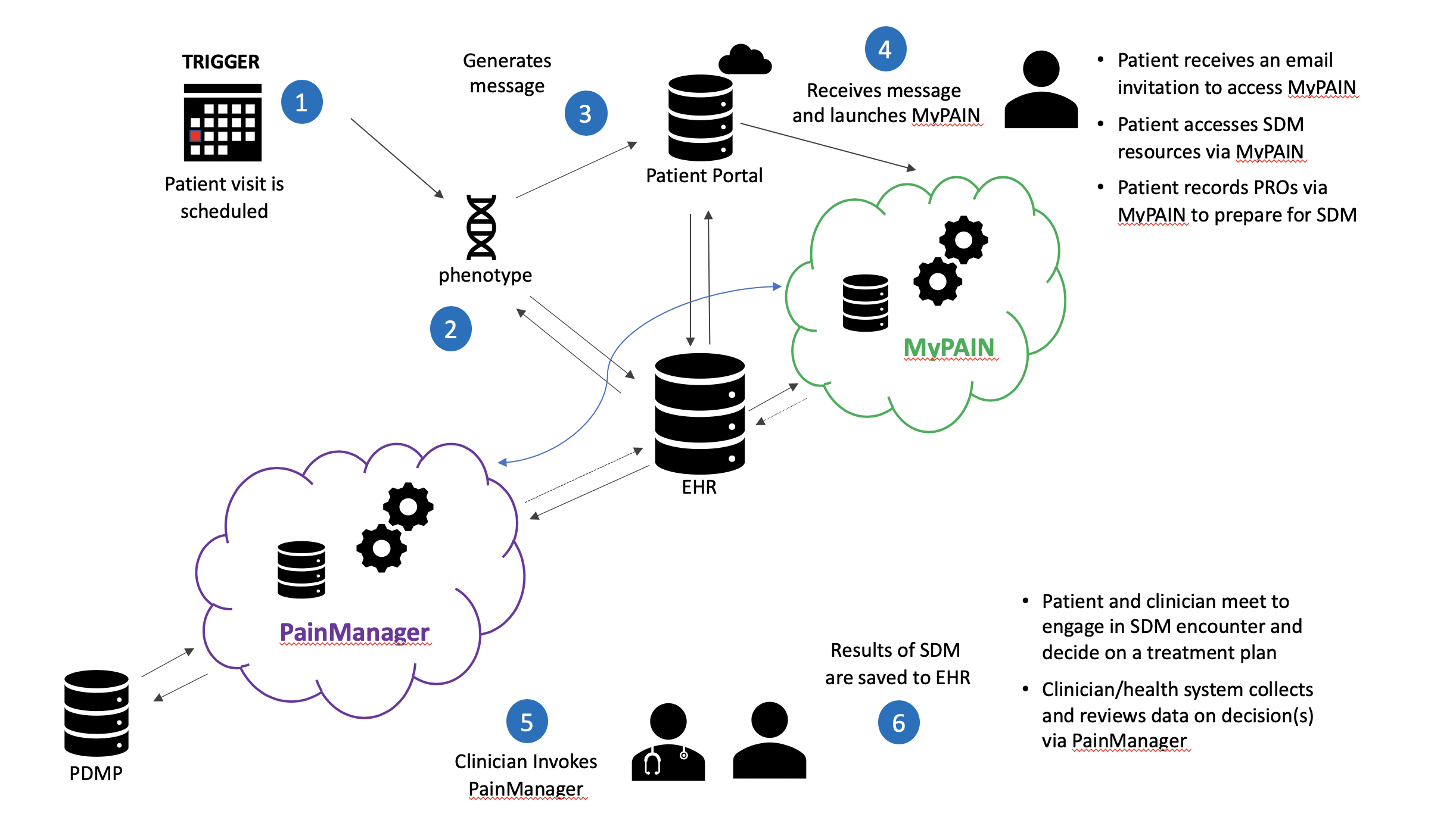
As this overview illustrates, the basic capabilities of the system are:
Based on assessment of available standards both for describing the capabilities required for the CDS4CPM system, as well as the current level of adoption of those capabilities, this implementation guide is focused on supporting the MyPAIN and PainManager applications. Implementing sites will be responsible for the process of identifying eligible patients, as well as the process for enrolling those patients with the MyPAIN application. However, as a starting point, this implementation provides a standards-based initial qualifying query:
For a complete description of the data elements used within the system, refer to:
For an assessment of the standards-based clinical content used within the system, refer to:
For a detailed description of the system design, refer to:
For a description of the approach to testing and validation of the system, refer to:
For a description of the implementation, development, and testing environment, refer to:
IG © 2019+ CQF. Package cqf.fhir.cds4cpm#0.1.0 based on FHIR 4.0.1. Generated 2021-05-13
Links: Table of Contents |
QA Report
| Version History  |
|